
Ground-source · highest efficiency
Geothermal heat pump installation
Ground-source systems extract heat from the earth at a constant 8-12°C year-round. Highest efficiency, longest lifespan (25-50 years), largest upfront cost. Eligible for the full Greener Homes Loan.
- Free quotes within 24 hours
- Licensed + insured installers
- Cold-climate-rated (CCHP) systems
- Greener Homes Loan paperwork handled
Typical installed cost
$25,000–$45,000
Install timeline
5–10 days
Best for
Long-term owners (10+ years), large homes with high heating loads, properties with land for horizontal loops, and homeowners who want the lowest possible operating cost
Not ideal for
Short-term owners, small homes, dense urban properties without yard space (vertical loops are possible but pricier), or budget-constrained projects
Rebates: Geothermal is the highest-rebate heat pump category in Canada. The full $40,000 Greener Homes Loan is typically used. Some provinces offer geothermal-specific top-ups beyond the air-source heat pump rebate.
- Free quotes within 24 hours
- Licensed + insured installers
- Cold-climate-rated (CCHP) systems
- Greener Homes Loan paperwork handled
How geothermal works
A geothermal heat pump uses the earth as its heat exchanger instead of outdoor air. A loop of buried pipe (the "ground loop") circulates water-glycol antifreeze through the soil, which stays at a constant 8-12°C year-round below the frost line. The indoor heat pump unit transfers heat between the loop fluid and your home — extracting heat from the ground in winter, dumping heat into the ground in summer.
Because the source temperature is always 8-12°C (instead of -25°C outdoor air for air-source heat pumps in winter), the system operates at peak efficiency year-round. Real-world COP (coefficient of performance) of 4-5 is typical for geothermal, versus 2-3.5 for air-source heat pumps. Translation: your heating bills drop another 40-60% vs. a high-efficiency air-source unit.
Horizontal vs. vertical loops
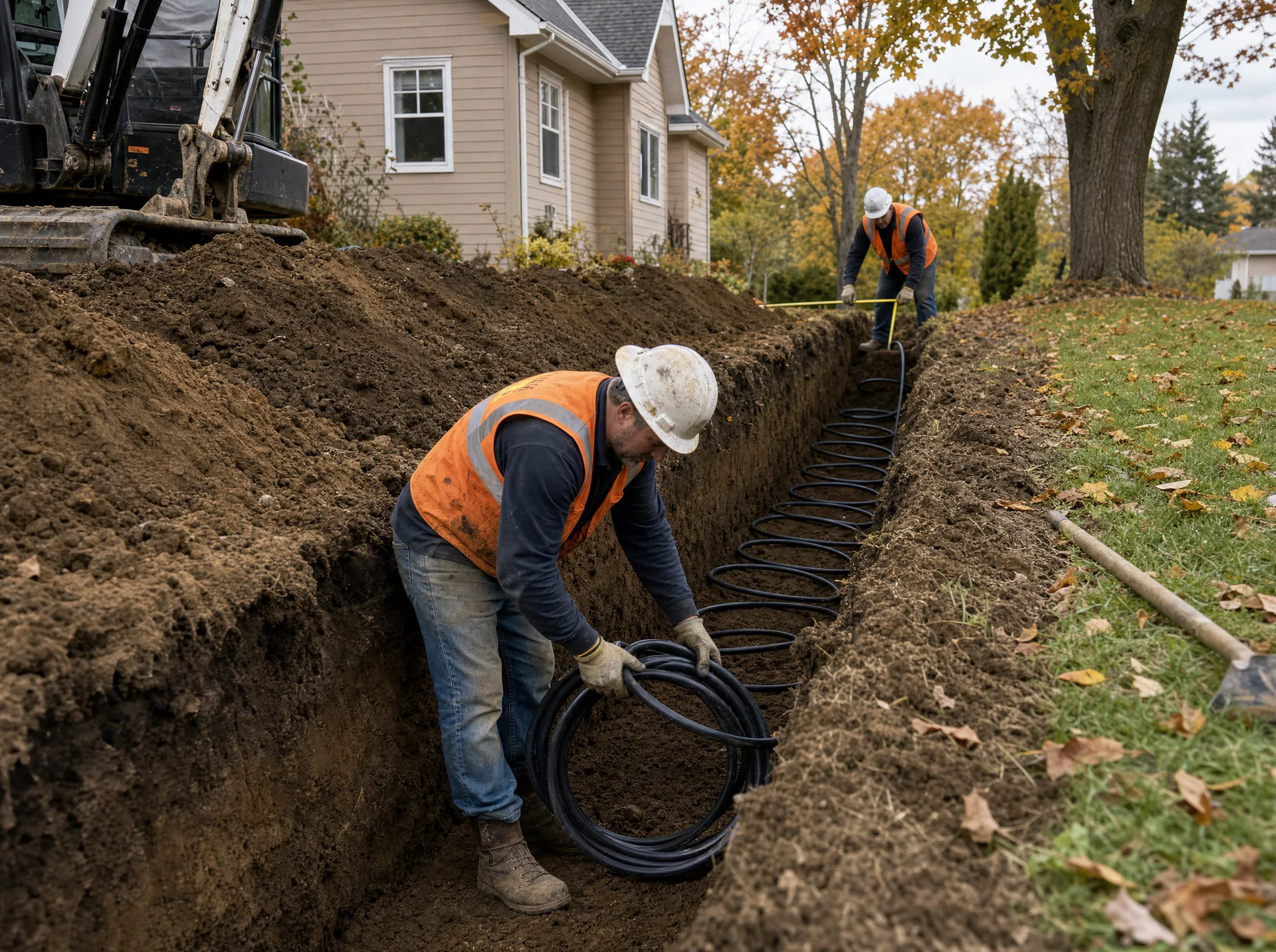
Horizontal loops are buried 1.5-2 metres deep across a 1,500-3,000 sq ft area of your yard. They're cheaper to install ($25,000-$35,000 total system cost) but require land. Good fit for rural and suburban properties.
Vertical loops are drilled boreholes 100-150 metres deep, with pipe inserted into the holes. They take very little surface area but cost $10,000-$15,000 more due to drilling expense. Required for dense urban lots.
Pond loops (if you have a pond on your property deep enough — at least 2.5 metres) are the cheapest option at $20,000-$28,000 total. Rare but excellent if available.
A geothermal-specialized installer will assess your property and recommend the loop type with a clear cost breakdown.
When the economics work
Geothermal's upfront cost is 2-3× an air-source heat pump. The payback comes from two sources:
1. Operating cost — 40-60% lower heating bills than air-source heat pumps; 70-80% lower than electric resistance; 50-70% lower than oil or propane 2. System lifespan — Indoor unit lasts 20-25 years (vs 12-15 for air-source). Ground loop lasts 50+ years.
Typical payback period in Canada with current rebates: 8-15 years. For a homeowner staying 15+ years in a high-heating-load home (large square footage, cold climate, currently on oil or electric resistance), geothermal is the best long-term investment.
For shorter-term owners (under 10 years), air-source heat pumps usually win on net present value.
Find a qualified installer
This site is an independent guide. It does not sell or install heat pumps and does not provide quotes. The programs and directories below are where to find registered contractors and the rebate rules that apply in each province.
- Canada Greener Homes Loan (NRCan)
The federal interest-free loan. The official page lists eligibility, the registered energy-advisor requirement, and how to apply.
- Oil to Heat Pump Affordability Program (NRCan)
Federal support for households switching from oil heat, with the current eligibility rules and application steps.
- HRAI contractor directory
The Heating, Refrigeration and Air Conditioning Institute of Canada lists member HVAC contractors by region.
- Save on Energy — Ontario
The Ontario heat pump incentive program and its list of participating contractors.
- CleanBC Better Homes — British Columbia
Provincial rebates for BC, including the program registered-contractor search.
- Efficiency Nova Scotia
Nova Scotia rebate programs and the approved-installer requirements that go with them.
Common questions
How disruptive is the installation?
Horizontal loop installation requires excavation across a 1,500-3,000 sq ft area of your yard. The yard is dug up, the pipe is laid, and the ground is restored — but landscaping (grass, plantings) is destroyed. Plan for full yard restoration after installation. Vertical loop installation is less disruptive — only the borehole sites are touched (basketball-sized holes that backfill cleanly).
What if I sell my house?
Geothermal systems are a documented selling point — they typically add $15,000-$20,000 to home resale value in Canada, especially in colder climates. The buyer inherits the lowest heating bills in the neighbourhood.
Can I add geothermal to an existing home, or only new construction?
Both. Retrofit installations are common — the indoor unit replaces your furnace, and the ground loop is installed in your existing yard. Costs are slightly higher than new construction (15-20%) due to landscape restoration and integrating with existing ductwork.