
Oil-to-heat-pump conversion
Oil-to-heat-pump conversion across Canada
Replace an oil furnace and tank with a modern cold-climate heat pump. The federal Oil to Heat Pump Affordability program closed to applications on July 31, 2026; provincial and income-qualified programs are open now, and the new federal National Heat Pump Rebate is due in early 2027.
- Independent — not an installer
- No forms, no lead selling
- Federal and provincial rebates tracked
- Cold-climate (CCHP) performance data
Typical installed cost
$12,800–$21,000
Install timeline
2–3 days (including oil-tank decommissioning)
Best for
Homes currently using oil heating (most common in Nova Scotia, New Brunswick, Newfoundland, PEI, rural Ontario, and Quebec). Income-qualified households may qualify for additional grant support.
Not ideal for
Homes that have already converted away from oil, or homes with natural-gas connection (gas-to-heat-pump uses different rebate structure)
Compare installed costs for every heat pump system.
Rebates: The federal Oil to Heat Pump Affordability program stopped taking applications on July 31, 2026. Newfoundland and Labrador's income-qualified takeCHARGE Oil to Electric program pays up to $22,000 for a central system; elsewhere, provincial rebates apply as for any heat pump. The federal National Heat Pump Rebate, announced in October 2026 and due in early 2027, will cover oil-heated homes: up to $10,000 below the median income and $2,000 for others.
- Independent — not an installer
- No forms, no lead selling
- Federal and provincial rebates tracked
- Cold-climate (CCHP) performance data
What happened to the Oil to Heat Pump Affordability program
The Oil to Heat Pump Affordability program (OHPA) was a federal, income-tested grant of up to $10,000 toward replacing oil heat with a heat pump, including tank decommissioning. It was the main driver of oil conversions in the Atlantic provinces. Natural Resources Canada set July 31, 2026 as the last day to apply.
What remains for oil-heated homes:
- Provincial rebates that apply to any heat pump, listed by province on the rebates page - takeCHARGE Oil to Electric in Newfoundland and Labrador: up to $22,000 for a central system or $18,000 for a multi-split, for income-qualified households - No-cost retrofit programs for low- and median-income households in British Columbia, Manitoba, Nova Scotia and Newfoundland and Labrador, under the Canada Greener Homes Affordability Program. Newfoundland and Labrador's version, the TakeCharge Greener Homes Program, covers one mini-split heat pump per home - The federal National Heat Pump Rebate, from early 2027: up to $10,000 for households below the median income and $2,000 for others
What conversion includes
A full oil-to-heat-pump conversion is a 3-step project:
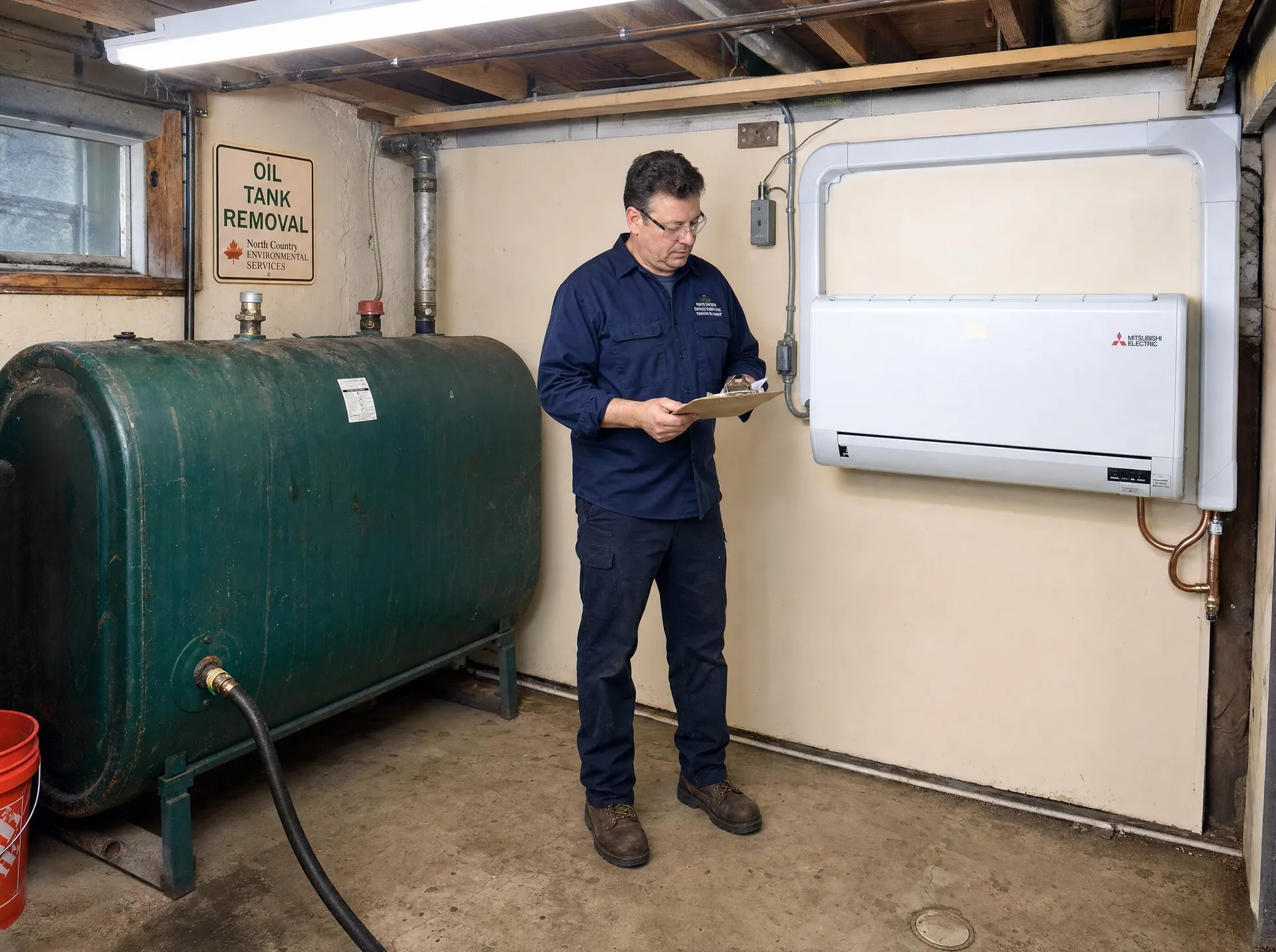
1. Oil tank decommissioning — your oil tank is drained, removed, and disposed of per provincial environmental regulations. Tank size, age, and condition determine cost ($800-$2,000 typically). 2. Heat pump installation — either ducted (if you have existing ductwork around the furnace) or ductless multi-zone (for radiator/baseboard homes). Cold-climate certified, sized for your home's heating load. 3. Electrical service upgrade if needed — oil-heated homes often have lower electrical capacity (60-100A panels). Many conversions require an upgrade to 200A service.
Total install time is typically 2-3 days. You'll be without primary heat for 1 of those days (do conversions in spring/fall, not mid-winter).
Why oil conversion is the highest-ROI heat pump install
Oil is the most expensive primary heating fuel in Canada — typically 2-3× the cost per unit of energy compared to a heat pump. A typical Maritime home using 2,000 litres of oil per year spends $2,000-$2,800 on heating fuel alone. A heat pump cuts that to $700-$1,200 in electricity.
Annual savings of $1,000-$1,500 make oil the fuel where a heat pump pays for itself fastest; the federal government's own estimate is more than $1,400 a year for homes leaving oil. How fast depends on the rebate: provincial programs today, plus the federal National Heat Pump Rebate once it opens in early 2027 ($2,000, or up to $10,000 for households below the median income).
This is why the Maritimes have the highest heat pump adoption rate in Canada — the math is overwhelming.
Find a qualified installer
This site is an independent guide. It does not sell or install heat pumps and does not provide quotes. The programs and directories below are where to find registered contractors and the rebate rules that apply in each province.
- National Heat Pump Rebate (Government of Canada)
The new federal rebate announced in October 2026: up to $10,000 below the median income and $2,000 for others, opening in early 2027. The official page has a sign-up for launch updates.
- Canada Greener Homes Affordability Program (NRCan)
No-cost heat pump and insulation retrofits for low- and median-income homeowners and tenants, applied for through the provincial partner. The federal Greener Homes Loan and Oil to Heat Pump Affordability program are closed.
- HRAI contractor directory
The Heating, Refrigeration and Air Conditioning Institute of Canada lists member HVAC contractors by region.
- Home Renovation Savings — Ontario
Ontario's rebate for cold-climate and ground-source heat pumps, paid per ton, and its qualified-product rules.
- Home Renovation Rebate — British Columbia
The BC Hydro and CleanBC rebate for heat pumps that replace electric heat, and the program rules that go with it.
- Efficiency Manitoba
Manitoba rebates for ducted and ductless cold-climate heat pumps.
- Efficiency Nova Scotia
Nova Scotia rebate programs and the approved-installer requirements that go with them.
Common questions
Is there still a federal grant for oil-to-heat-pump conversions?
Not one you can apply for today. The Oil to Heat Pump Affordability program closed to all applicants on July 31, 2026. Its successor, the National Heat Pump Rebate, was announced on October 8, 2026 and is due to open in early 2027: up to $10,000 for households below the median income and $2,000 for others, for oil-heated homes and others. Income matters again under it. Until it opens, provincial rebates are the main support; the rebates page lists them by province.
Can I keep my oil tank for backup?
Yes — some installers will keep your oil furnace and tank as backup heat for the coldest days (a "dual-fuel" arrangement). The trade-off is that the tank, its upkeep and an oil bill all stay, and some provincial rebates only pay for a system that replaces the old heat entirely.
How is the oil tank disposed of?
Provincial regulations vary, but standard practice is: drain remaining oil (resold to your supplier), clean the tank with industrial absorbent, then either recycle (steel tanks) or dispose at a hazardous waste facility (fibreglass tanks). Your installer handles the paperwork and disposal; keep the written confirmation that the tank was removed.